My name is Shin Haneul, and I was thirty seconds away from ruining a man's life when his hands started shaking.
Not the bold kind of shaking, the kind that precedes a fist. This was fine motor failure. The tendons in his wrists jumping under skin that had gone the colour of old rice paper. His fingers were wrapped around a teacup he hadn't touched in twenty minutes, and the tea inside was cold, and the cup was chattering against the saucer like a tiny porcelain animal trying to escape.
I watched the cup. I let him see me watching.
"Mr. Bae," I said. "I think we both know I didn't come here for the bulgogi."
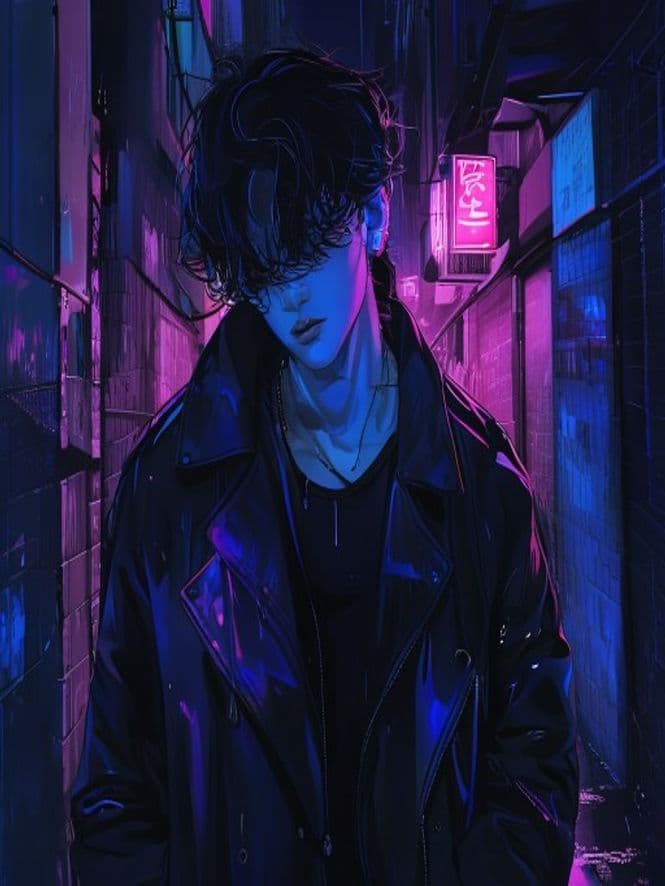
The restaurant was empty. Ten p.m. on a Wednesday in Hagu-dong, which meant the dinner rush had petered out an hour ago, and the kitchen staff had been sent home with the kind of urgent hand gestures that told me Mr. Bae had been expecting this visit. The chairs were stacked on half the tables. The overhead fluorescents buzzed at a frequency that lived somewhere behind my left eye. Through the plate glass window, Hagu-dong did what Hagu-dong did at night: bled neon onto wet asphalt, pink and electric blue running together in the gutters like something alive.
"I have until Friday," Bae said. "That's what they told me. Friday."
"That was three Fridays ago."
His mouth opened. Closed. The cup kept chattering.
I leaned back in my chair. The vinyl seat cover was cracked and repaired with electrical tape, and it stuck to the back of my leather jacket with a soft tearing sound every time I moved. I pulled a cigarette from the sky-blue pack of Raison Blues in my breast pocket and held it between my fingers without lighting it. A prop. Something to occupy my hands while his fell apart.
"Forty-two million won, Mr. Bae. That's the principal. The interest is another eleven. Fifty-three total. You know this."
"I know this."
"And you know what happens when this number gets handed to someone who isn't me."
He knew. Everyone in Hagu-dong knew. The Yun Syndicate had a spectrum of debt collection, and I occupied the polite end of it. The end with conversation and tea and the illusion that this was a negotiation between equals. Past me on that spectrum, there was Park Seojin with his fox grin and his two knives. Past Seojin, there were men whose names I'd never learned because names weren't relevant to what they did.
Bae set the cup down. It took him two attempts. "My daughter," he said.
I waited.
"Yejin. She's eleven. She's sick." He looked at the table. "Lymphoma. Stage two. The treatment at Haemun General, the good treatment, not the public ward, it costs more than this restaurant makes in a year. That's where the money went. All of it. I borrowed to pay for her treatment and now I can't pay for the borrowing and if I stop the treatment she..." He trailed off. His jaw worked around something he couldn't make into words.
The fluorescents buzzed. Outside, a stray cat screamed at something in the alley, and the sound was almost human.
I rolled the unlit cigarette between my thumb and forefinger. The paper crinkled softly. Inside my chest, something pressed against the walls I'd built there, and I held it down with the flat professional weight of twenty-six months of practice.
"Mr. Bae. Look at me."
He looked. His eyes were red-rimmed and dry. He'd run out of tears before I arrived. Probably days ago.
"You have assets," I said. "The restaurant lease. The kitchen equipment. You have a Hyundai Sonata, 2019 model, parked in the alley behind the building. Blue. You have a life insurance policy through Hanwha, medium-term, taken out four years ago."
His face changed. Not to fear. To something flatter than that. The realisation that he'd been researched.
"Here's what I'm going to recommend to my superiors." I placed the cigarette on the table, parallel to the edge, precise. "You liquidate the Sonata. That's roughly eight million. You sign over the insurance policy assignment, which gives us a guaranteed payout schedule. That covers twenty-six million over three years. The remaining nineteen, we restructure at reduced interest, monthly payments indexed to the restaurant's revenue."
"That's... you can do that?"
"I can recommend it. Whether they accept depends on how convincing I am."
"Why would you..."
"Because a dead man doesn't pay his debts, Mr. Bae. And a man who loses his restaurant doesn't either. The Syndicate isn't a charity, but it's not stupid. You alive and working is worth more than your organs."
Crude. Deliberately crude. I needed him scared enough to comply and grateful enough not to run. The balance mattered. Push too far and they vanish in the night, which means I failed the collection, which means attention I couldn't afford. Not far enough and they think the terms are negotiable, which means the same thing.
Bae nodded. His hands had stopped shaking. Direction will do that. Give a drowning man a piece of driftwood and he stops thrashing.
"The paperwork for the Sonata," I said. "Bring it to the Vein building, third floor, Friday. Ask for Han. Not anyone else. Me."
"Han."
"That's right."
I stood. Tucked the cigarette behind my ear. Pulled my jacket straight. On my right thumb, my mother's ring caught the fluorescent light, and for half a second, the silver threw a coin of brightness onto the wall behind Bae's head. A tiny halo. There and gone.
"Mr. Bae."
He looked up.
"Your daughter's treatment. Don't stop it."
I left before he could respond. The door chime rang a flat, electronic note behind me, and then I was outside, and Hagu-dong swallowed me whole.
The night was warm and wet. Not raining, but remembering rain, the air thick enough to leave a film on exposed skin. I walked south through the district with my hands in my jacket pockets and my collar up, moving at the pace of a man going nowhere in particular. Neon signs stacked three high along the narrow street: a hostess bar, a PC bang, a karaoke place with a sign that read STAR GALAXY PREMIUM in English letters that flickered between hot pink and dead. The gutter ran with oily water. Somewhere to my left, a street vendor was still frying scallion pancakes, and the smell hit me low in the stomach, sesame oil and batter and the char of a griddle that hadn't been cleaned since the last administration.
I turned the ring on my thumb. A habit. The silver was worn thin on the inside from two years of this exact gesture, my skin slowly eating the metal my mother once wore.
Two blocks. Three. Past the jjimjilbang with its fogged windows and its hand-painted sign. Past the alley where the Syndicate ran a card game every Thursday. Past the convenience store where the night clerk, a kid named Dohyun who couldn't have been older than nineteen, was leaning in the doorway scrolling his phone, bathed in the store's white light like a saint in a painting.
Four blocks south. Then east, away from the commercial strip into the concrete residential grid where the streetlights worked on a two-out-of-three basis and the buildings crowded together like they were trying to keep warm. I cut through a playground that hadn't seen a child in years. The swing set was rusted solid. A cat watched me from the top of the slide with the flat, appraising stare of a landlord.
The parking garage was underneath an apartment complex on the eastern edge of the district. Eight stories of water-stained concrete with a population of approximately four working vehicles and an unlimited number of rats. I took the pedestrian entrance, a steel door with no handle on the outside that I opened with a bump key, and descended the stairs to sublevel two. The stairwell smelled like piss and engine coolant. The fluorescent tubes overhead were the same sickly frequency as Bae's restaurant, and I thought, not for the first time, that Hagu-dong's entire electrical grid was tuned to the precise wavelength of despair.
Sublevel two. Three cars: a dead Kia with no plates, a construction van that hadn't moved in months, and a black Hyundai Grandeur with tinted windows and the engine running. Exhaust fumes pooled in the low-ceilinged space, mixing with the mineral smell of wet concrete. I could see the cherry-red ember of a cigarette floating behind the Grandeur's cracked driver-side window.
Dunhill. Not Raison. The smoke was heavier, richer. That was how I always found Minjun. Follow the expensive cancer.
I walked to the passenger side and got in.
Cha Minjun was forty-one and looked fifty-five. Lean, hollowed out, with the permanent under-eye bruising of a man who had been sleeping four hours a night for fifteen years and had stopped noticing. His hair was cropped short and going grey at the temples. He wore a dark wool coat over a shirt that might have been white that morning. The Dunhill was between his index and middle fingers, and he held it the way smokers held cigarettes in films from the eighties, with a kind of practised elegance that suggested he'd learned the gesture before the habit.
"You're late," he said.
"Collection ran long."
"The restaurant owner? Bae?"
"Handled. He'll liquidate the car, sign over the insurance assignment. I'll push a restructure."
Minjun took a drag. The ember brightened, painting his cheekbones in orange light, and then faded. "You're good at this."
"You say that like it's a compliment."
"It is."
"It shouldn't be."
He exhaled smoke through his nose. It filled the car like a slow, grey thought. Through the windshield, the parking garage stretched out in rows of empty spaces marked by faded yellow paint. The ceiling was low enough to feel like a hand pressing down.
"Report," he said.
I reported. Twenty-six months of cover maintenance had turned debriefing into something mechanical: names, dates, amounts, movements. I gave him the week's intelligence in flat, ordered sentences. A shipment rerouted through Pier 9 last Tuesday, estimated street value of three hundred million won. Kwon Mirae had restructured the Club Vein accounts through a new shell company registered in Sejong. Seojin had beaten a man named Cho outside the jjimjilbang over a gambling debt, broken his left orbital bone, and Cho was now at Haemun General telling the nurses he fell down stairs. Yun Jaewon had not been seen outside The House in eleven days.
Minjun listened. He didn't take notes. He never did. Everything went into the device clipped to the sun visor, recording in a format that would be transcribed at the Sangji field office by someone who had never smelled Hagu-dong and never would.
When I finished, the silence sat between us. The engine idled. Minjun smoked his Dunhill down to the filter and crushed it in the ashtray, which was already full.
"There's a development," he said.
I waited.
"The brass is escalating. We've been building a peripheral case for two years, and they want the centre." He turned to look at me. His eyes were the colour of black coffee, flat and assessing. "They want someone in Dowan's inner circle. Not the Syndicate's orbit. Not collections and club work. Inside. Close enough to document the pipeline from source to street, and the political connections above it."
My thumb found the ring. Turned it. The silver was cool against my skin.
"Dowan doesn't let people close," I said.
"No. He doesn't."
"The inner circle is Seojin and Mirae. That's it. Everyone else is staff."
"Which is why we need you promoted. Not in rank. In proximity." Minjun lit another Dunhill. The flame from his lighter threw shadows across his face that made him look like a woodcut of someone already dead. "You've been noticed. Your work on the collections has been clean, efficient. The Syndicate values competence. Dowan values it more than most."
"You want me working directly under Yun Dowan."
"Starting tomorrow."
The word sat in the car like a third passenger.
"That's fast," I said.
"The timeline has accelerated. Political pressure from above. Someone in the National Assembly is getting nervous about the Haemun port contracts, and they want results before the next election cycle. The director has signed off. This is happening, Haneul."
Haneul. My real name, said by the only person alive who knew it was real. In Minjun's mouth, it always sounded like a reminder. Or a question.
"Dowan is not his father," I said. "He's smarter. More observant. If my cover has any inconsistency, any gap, he'll find it."
"Then don't have gaps."
"Everyone has gaps."
Minjun looked at me. The Dunhill smoke curled between us, and for a moment the only sound was the engine and the distant drip of water from the parking garage's broken drainage pipe, a metronome counting nothing.
"Are you still you?" he asked.
The question he asked every time. His check-in. His welfare assessment, dressed up as three words casual enough to deny in a report.
"I'm still me," I said.
He held my gaze for two beats longer than the words required. Then he nodded. Turned back to the windshield. Took a drag.
"You report to The House at nine a.m. Dowan's office, third floor. Seojin will escort you. Don't be charming. Don't be clever. Be exactly what your file says: a competent collector with no ambition beyond his next payday."
"And what am I actually doing?"
"Everything. Shipment manifests, financial records, personnel connections. We need the thread that runs from the Hagu-dong pipeline to the assemblyman's office in Sangji. That thread goes through Dowan. He manages the operational layer between street-level crime and political money. Get close enough to document it."
"How close is close enough?"
"You'll know." He crushed the second Dunhill. "One more thing. The Bae collection."
"What about it?"
"His daughter. The sick one."
My hand stopped turning the ring. "What about her?"
"Nothing. Just remember she exists. Remember he's a person. The day you stop noticing that is the day I pull you out."
I opened the car door. The garage air hit my face, damp concrete and exhaust, and it felt cleaner than the air inside the Grandeur, which was sixty percent Dunhill smoke and forty percent things neither of us would say.
"Haneul."
I paused, one foot on the concrete.
"The House," Minjun said. "Have you ever been inside?"
"No."
"No one on our side has. Not in three years of this operation. Whatever you see in there tomorrow, keep your face still. You're not an agent walking into an intelligence target. You're a debt collector who's been called up. Act like it."
"I know how to act."
Something moved behind his eyes. Something that might have been concern, if Minjun were the kind of man who let concern survive long enough to be visible.
"That's what worries me," he said.
I shut the door. Walked back across the empty parking level, my boots echoing on concrete that had never been warm. Up the stairwell. Out the steel door into the night.
Hagu-dong was quieter now. Past midnight, and the district had settled into its late shift: the hostess bars still glowing, the street vendors packing up their carts with a clatter of metal and propane, a few drunks navigating the sidewalks like men crossing a frozen river. The fog had rolled in from the harbour, and it erased the tops of the buildings and softened the neon into smeared halos of colour that seemed to float in the air unattached to anything.
I walked home. Block 7 was a concrete apartment stack that looked like it had been built angry and never recovered. The elevator had been broken since before I moved in. The stairwell smelled like bleach and someone else's cigarettes. Fourth floor. My door. The lock was cheap, the kind you could defeat with a credit card and determination, and I'd left it that way on purpose. A better lock would have been a question without an answer my cover could provide.
Inside. One room. Mattress on the floor, sheets tangled from this morning. The ashtray on the windowsill, overflowing. Ramyeon cups stacked on the counter like a skyline made of sodium and regret. The window looked out onto the fire escape and the karaoke bar across the alley, whose sign was in its red phase tonight, painting everything in the room the colour of a wound.
I didn't turn on the light. I stood in the doorway and let the red wash over me and waited for the thing I always waited for when I came back to this apartment: the moment when the performance ended and whatever was underneath it was supposed to surface.
It didn't come. It hadn't come in months. The cover and the man had grown together like two trees planted too close, their roots tangled underground in ways I couldn't separate without killing one or both.
Han, the collector. Efficient. A little mean. Quick with a line that cut. He was easy. He fit the world he lived in the way a key fits a lock, and the door he opened led to rooms I understood: debts, leverage, the arithmetic of fear.
Shin Haneul, NIS agent. Mission-oriented. Disciplined. Trained at twenty-two, deployed at twenty-five, undercover at twenty-five and a half. He was a file in a drawer in the Sangji field office, a set of quarterly performance metrics, a voice on Minjun's recordings.
And then there was whoever stood in this apartment at midnight with the red light on his face, turning a dead woman's ring on his thumb, and I didn't have a name for him. I wasn't sure he had one. I wasn't sure he was anyone at all.
I went to the bathroom. Crouched beside the sink. Reached under the basin where the pipe met the wall and pressed my fingers against the duct tape until I felt the hard rectangle of the phone. My real phone. The one that connected to encrypted NIS servers and contained enough evidence to put me in a Syndicate grave within the hour.
Still there. Still taped. Still ticking like a second heartbeat in a body that was already running out of room.
I didn't pull it out. I just touched it. Confirmed it. The way you touch a scar to remember the wound, even when you'd rather forget.
Tomorrow I would walk into The House. The Yun Syndicate's heart. The place where Yun Jaewon ran his empire from a room full of screens, where Dowan managed violence like other men managed spreadsheets, where the soundproofed basement served purposes no one discussed. I had spent twenty-six months circling that building, collecting debts in its shadow, feeding intelligence about its edges. I had never been inside.
Tomorrow, I would be.
I stood up. Washed my face with cold water. Looked at myself in the mirror above the sink. The red neon from the bedroom reached even here, and in the glass I looked like something developing in a darkroom, half-formed, the image not yet fixed.
My mother's ring glinted on my thumb. The only true thing I carried.
I dried my face and went to the window. Lit the cigarette I'd been carrying behind my ear since Bae's restaurant, the one I'd used as a prop and then forgotten was there. The first drag hit my lungs like a small, familiar punishment. I exhaled into the red-stained air and watched the smoke dissolve against the glass.
Nine a.m. The House. Third floor. Dowan's office.
I had never met Yun Dowan. I'd seen him three times: once outside Club Vein, crossing the street in a black coat with Seojin at his heels, moving through the crowd like a blade through water. Once on the CCTV footage Minjun had shown me during a briefing, Dowan sitting at a desk, reviewing papers, his face revealing exactly nothing. Once at a Syndicate gathering I'd attended as peripheral staff, watching him across a room full of men who were afraid of him, and noticing that his hands, when he held his glass, were very still.
Three sightings. A file two inches thick. Twenty-six months of secondhand intelligence. None of it told me what it would be like to stand in front of him and lie.
I finished the cigarette. Crushed it in the ashtray with the others. Lay down on the mattress without undressing and stared at the ceiling, where the red light made slow, shifting patterns as the karaoke sign across the alley flickered between alive and dead, alive and dead, alive and dead.
I closed my eyes.
I was still me.
I was still me.
Nine a.m.
What did you think of this chapter?
Drop your thoughts and get notified when new chapters arrive. The author reads every message.
Continue reading
Chapter 2→