The woman in the mirror was wearing a wedding dress, and I wanted to set her on fire.
My name is Sera Maren. In eleven days, I would become Sera Valenti, and the seamstress kneeling at my feet had no idea she was pinning silk to a loaded gun. She worked a needle through the hem with the quiet efficiency of someone who'd dressed a thousand brides and believed in every single one. The dress was Vera Wang. Column silhouette, off-the-shoulder, Italian mikado fabric so white it made my skin look like something carved from warm stone. Forty-seven thousand dollars of bridal fantasy, charged to my father's account. He could afford it. He was selling his daughter. The least he could do was wrap her nicely.
"Stop fidgeting," Lena said from the champagne-coloured settee behind me. She had her legs crossed, a glass of Veuve in one hand, and the expression of a woman trying very hard not to cry or commit a felony. Possibly both. "You look incredible."
"I look like a sacrifice."
"You look like a Vogue cover. Same energy, I guess."
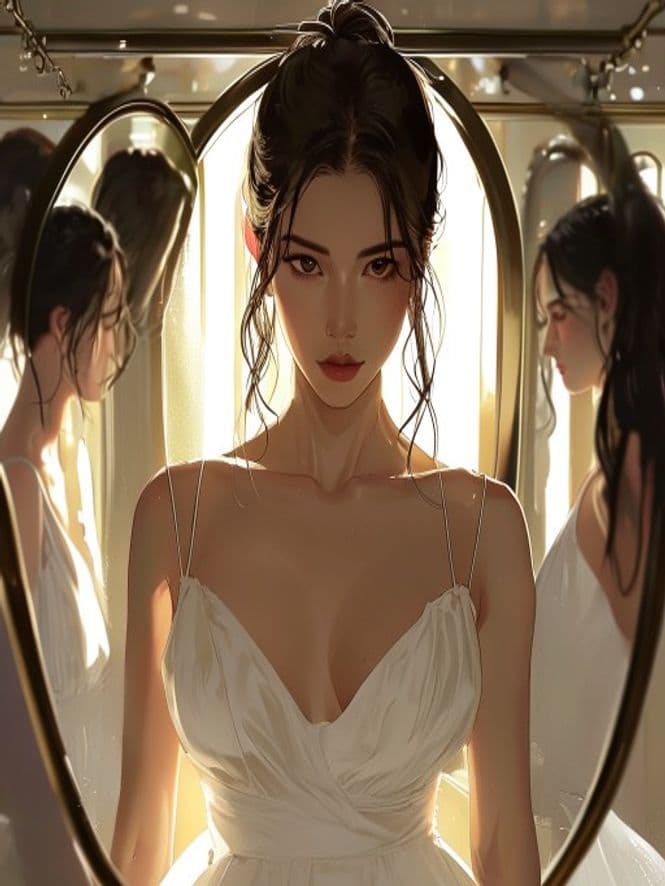
I studied my reflection. Kleinfeld's fitting room was designed to make women fall in love with themselves. Circular platform, three angled mirrors, lighting calibrated to erase every flaw and amplify every curve. The walls were ivory. The carpet was ivory. The champagne was golden and the chairs were blush and everything in this room existed to whisper yes, this is who you were always meant to be.
It was suffocating. All that white. All those mirrors. Twelve versions of me stared back from every surface, and not one of them looked like a woman about to marry for love.
Good. Love was not the assignment.
The seamstress shifted on her knees, tugging the fabric tighter at my waist. Her fingers were quick and sure. A pin appeared between her lips, then in the silk.
"You carry tension here," she said, pressing two fingers to the spot where the dress met my ribcage. "And here." She touched my shoulder. "I can let out the bodice a quarter inch. It won't change the line, but you'll breathe easier."
"She doesn't breathe easier," Lena said. "That's her whole thing."
I shot her a look through the mirror. She raised her glass and didn't apologize.
The seamstress moved to my left side and paused. Her eyes caught on my wrist. The tattoo was small, precise black ink against the inside of my forearm: III. Roman numeral three.
"That's lovely," she said. "What does it mean?"
I pulled my hand away. Not fast, not rude. Controlled. The way I did everything.
"Family," I said.
She smiled and went back to the pins. She didn't push. People rarely did. There was something in the way I said the word that shut doors.
III. Third of three. Marcus, Celia, Sera. The Maren children, raised in glass towers and silence, each of us bright and sharp and built to cut. Marcus was the eldest. Twenty-three when he died, his car wrapped around a guardrail on the Long Island Expressway, a story I had swallowed like shrapnel and carried in my chest for seven years. Celia was the youngest. Twenty when the pills stopped her heart, curled on a bathroom floor in a Soho apartment she couldn't afford, wearing a dress she'd bought to impress people who didn't care if she lived or died.
I was the middle. I was the one who survived. I was the Roman numeral that mattered, the only digit in that sequence that still had a pulse, and some mornings the weight of that felt like drowning in open air.
But I did not think about that in the fitting room. I thought about angles. Exits. The task at hand.
"So," Lena said, setting down her champagne with the careful precision of someone choosing her next words the way a surgeon chooses a scalpel. "Are we going to talk about it?"
"We're not."
"Because I feel like we should."
"You feel like we should talk about a lot of things. That's because you're a lawyer. You're pathologically incapable of leaving silence alone."
"I'm your best friend."
"Also true. And as my best friend, you know that when I say we're not talking about it, I mean exactly that."
Lena leaned forward. The settee creaked. Her dark curls fell across her forehead, and she pushed them back with a gesture so familiar it ached. I'd known her since law school orientation, when she'd sat next to me, taken one look at my colour-coded notes, and said, You're either going to be my best friend or my nemesis, and I don't have the energy for a nemesis. She'd been right. She usually was.
"Sera."
"Lena."
"You're marrying Nico Valenti."
There it was. The name. I let it land the way you let a wasp land on your skin, still, watchful, aware that any sudden movement would cause a sting.
Nico Valenti. Thirty years old. Dark-eyed, sharp-jawed, heir to an empire built on blood and territory and the kind of loyalty that only exists when the alternative is a shallow grave. His father, Dominic, had been shot dead at a family dinner five years ago. His younger brother, Luca, was beautiful and volatile and almost certainly the reason my sister had access to the pills that killed her. And Nico, the eldest, the one who sat at the head of that family like a king carved from black marble, had agreed to marry me as part of an alliance brokered by his mother and my father.
A ceasefire disguised as a wedding. A business merger sealed with two human lives.
My father had told me over dinner at the Maren Tower, his silver hair immaculate, his voice the same flat, boardroom monotone he used for everything, from quarterly earnings to the sale of his only living daughter. The Valentis have agreed. You'll marry the eldest. It secures the transition. It protects our assets. It ends the exposure. He'd turned his signet ring once, twice, three times. His tell. You'll do this for the family, Sera.
And I had looked at him across the white tablecloth and the crystal and the silence where my siblings should have been, and I had said yes.
Not because I was obedient. Not because I was afraid. Because I had spent seven years waiting for exactly this invitation. An open door into the house of the people who destroyed my family. A seat at their table. A place close enough to reach.
I didn't come to be a wife. I came to be a weapon.
"I know who I'm marrying," I told Lena.
"Do you? Because last time we discussed the Valentis, you referred to Nico as, and I quote, the reason I believe in hell."
"I contain multitudes."
"You contain a terrifying revenge fantasy that you think I don't know about."
I turned on the platform. The dress whispered against my legs. The seamstress made a small, distressed sound and reached for a pin that had come loose.
"Please hold still, Ms. Maren."
"I'm fine." I wasn't fine. My left hand had drifted to my wrist again, thumb pressing against the tattoo. I caught myself and stopped. Folded my hands in front of me. The seamstress noticed. I saw it in her eyes. She said nothing.
People who work with brides learn to read bodies the way soldiers learn to read terrain. She could see the tension threaded through me like wire, and she was smart enough not to pull it.
"I know what I'm doing," I said to Lena, quieter now. Not softer. There's a difference. Soft was a thing I couldn't afford. Quiet was a thing I could weaponize.
"I know you know what you're doing. That's the part that scares me." Lena uncrossed her legs and leaned back. "You've been planning something since Marcus died. Don't look at me like that. I know you. I've watched you build a case the way other people build houses, one brick at a time, every piece load-bearing. I've seen that notebook."
"Don't."
The word came out like a blade. Sharp, clean, final. Lena's mouth closed.
The notebook. Marcus's notebook. Black Moleskine, soft cover, filled with his handwriting, that angular, impatient scrawl that looked like a man in a hurry. I'd found it in his apartment two weeks after the funeral, hidden in a hollowed-out copy of The Art of War because my brother had always been smarter than anyone gave him credit for and more dramatic than he needed to be. Inside: names. Numbers. Dates. Valenti names and Valenti numbers and Valenti connections laid out in ink like a map of the thing that killed him.
I had memorized every page. I had built my life around those pages. And I did not talk about them. Not here. Not in a room full of mirrors and white fabric, where every surface was designed to reflect a woman who didn't exist.
Lena held up both hands. Surrender.
"Okay. Okay. I'm done."
"You're done."
"I'm done." She picked up her champagne. Took a long sip. Set it down. "But Sera?"
"Mm."
"If this is really what you want, then I'm with you. Maid of honour. Ride or die. All of it. But you have to promise me one thing."
I waited.
"Come back from it. Whatever you're walking into, whatever you're planning, come back. I can't lose you too."
The word too hung in the air between us. Lena had loved Marcus. Not romantically, but she'd loved him the way you love your best friend's older brother, that easy, uncomplicated warmth that exists without negotiation. She'd helped me pack Celia's apartment. She'd held my hair back while I threw up on the bathroom floor the night we got the call. She knew what the Roman numeral meant. She knew what every part of me meant, and she still chose to sit on this ridiculous champagne-coloured settee and drink expensive wine and pretend we were just two women at a bridal fitting, doing a normal thing, living a normal life.
I loved her for it. I would never tell her. But I loved her.
"I'll come back," I said.
She nodded. Wiped under her eye with one finger. Picked up her glass.
"Good. Now turn around. I need to see the back."
I turned. The dress moved with me, heavy and fluid, like water given shape. The seamstress stepped back to assess. I caught myself in the mirror again. Three of me. Always three.
Marcus had been the one who believed in people. He'd had this light in him, this stupid, stubborn faith that the world could be better than it was, that families like ours could change. He used to argue with our father at dinner, leaning forward with his elbows on the table and his eyes on fire, insisting that there was another way. Dad would sit there with his signet ring and his silence and wait for Marcus to run out of air. Marcus always ran out of air. He'd push back from the table and go to his room and call me, and I'd listen to him rage for twenty minutes, and then he'd laugh and say, Okay, I'm done. Tell me something real, Sera. Tell me something that matters.
I couldn't remember the last real thing I'd told anyone.
Celia had been the one who felt everything. She'd been wrecked by Marcus's death in a way that made the rest of us look functional. She'd started disappearing, slipping out of our lives like water through a cracked glass. I should have caught her. I should have held on tighter. But I was nineteen and furious and so consumed by my own grief that I'd mistaken her quiet for healing when it was really the sound of someone giving up. The pills were just the period at the end of a sentence that had been writing itself for years.
Two siblings. Two different kinds of gone. Both roads leading back to the same family name.
Valenti.
"The waistline is beautiful on you," the seamstress said, circling me now with a tape measure looped around her neck. "You have a dancer's frame. Long. But you're holding so much tension. Here, and here." She touched my shoulders again. "Try to drop them. You'll carry the dress differently."
I dropped my shoulders. Breathed. The dress settled against my collarbone like a hand.
"There," the seamstress said. She smiled. It was warm. Genuine. She saw a bride. She saw the dress and the occasion and the start of something, and she had no idea that the woman on her platform was not starting something. She was ending something. Or she was trying to.
"Two more adjustments at the hip," she said. "Then we'll do the veil. Twenty minutes."
She left to get supplies. The fitting room door closed behind her with a soft click, and then it was just Lena and me and twelve reflections.
"He's going to figure you out," Lena said quietly. "Men like that don't stay fooled."
"I don't need him fooled. I need him close."
"There's a difference?"
"A critical one."
Lena shook her head. She stood, smoothing the front of her red wrap dress. She was every colour I wasn't. Bold lipstick, gold hoops, a warmth that radiated from her like heat off pavement. Standing next to her, I looked exactly like what I was: a woman dressed in white who had no business wearing it.
"You know what your problem is?" she said.
"I'm sure you'll tell me."
"You think you can walk into that family, that house, that marriage, and feel nothing. You think you can sit across from him at breakfast and lie next to him at night and stay cold."
"I'm very good at cold."
"Yeah. You are. But what if he's warm?"
I didn't answer. My thumb found my wrist again. The ink. The number. The dead.
What if he's warm. As if warmth were something I needed. As if warmth were anything other than a tactic used by people who wanted something from you. The Marens ran cold, all glass towers and white marble and silence. If the Valentis ran warm, it was because fire was their weapon, and I knew better than to mistake it for comfort.
I looked at myself in the mirror. The dress. The bare shoulders. The dark hair pinned up in a knot so tight my scalp ached. The jaw that people called strong when they meant hard. The mouth that stayed flat because smiling was a currency I didn't spend cheaply.
Eleven days. In eleven days, I would walk down the aisle of a crumbling church in Little Italy toward a man whose family name I'd scratched into the margin of every document, every plan, every late-night list I'd made since I was nineteen years old. I would say vows I didn't mean. I would let him put a ring on my finger. I would move into his house and eat at his table and learn the shape of his empire from the inside, and I would find every crack, every fault line, every place where the structure was weakest.
And then I would pull.
"I need air," I said. "Can you handle the veil fitting?"
Lena blinked. "You're leaving me to make veil decisions? I have terrible taste in veils."
"You have terrible taste in men. Your taste in veils is fine."
"That's the nicest thing you've ever said to me."
I stepped off the platform. The dress pooled at my feet, unhemmed, trailing white silk across the ivory carpet. I gathered the fabric in both hands and walked toward the changing room. Lena watched me go. I could feel her watching. She had that look again, the one she thought she hid, the one that said I'm scared for you without using any words at all.
In the changing room, I stood alone. Smaller mirror. Harsher light. The dress was a costume. Everything in my life was a costume. The composed daughter. The dutiful executive. The grieving sister who had packed her grief into a box and labelled it motivation and stored it somewhere no one could touch it.
I reached behind my back and unzipped. The silk fell away. Underneath, I was just a body. Lean, scarred on the inside where it didn't show, held together by routine and rage and a plan I'd been sharpening for seven years.
I dressed in my own clothes. Black trousers, cream silk blouse, heels that added two inches and cost nine hundred dollars and made a sound on marble floors that said I am not someone you ignore. The Maren uniform. I buttoned the blouse at the wrist, covering the tattoo. Then I uncovered it. Then I covered it again.
III.
Marcus. Celia. Sera.
One buried. One cremated. One getting married.
I walked out. Lena was talking to the seamstress about cathedral-length versus fingertip. I caught her eye, mouthed thank you, and headed for the entrance.
Kleinfeld was busy. Brides everywhere, real brides, women who giggled and cried and spun in circles while their mothers clutched tissues. I moved through them like a knife through gauze. The door. The street. February air, sharp and clean, hitting my face like a corrective. Manhattan was grey and bright and loud around me, taxis honking, pedestrians weaving, the city doing what it always did: moving forward without caring who it left behind.
I stood on the sidewalk and breathed.
My phone buzzed.
I pulled it from my coat pocket. The screen was bright. One notification. A text message from an unknown number. No contact name. No context. Just ten words that rearranged something inside my chest before I could stop them.
You should know -- he chose you. Not your father's offer. You.
I stared at the screen. The letters were black on white. Clear. Certain. They could have meant anything. They could have been a wrong number, a mistake, a misfired message from some other story.
But they weren't. I knew they weren't. Because the feeling that moved through me when I read them was not confusion. It was recognition. The sick, unwanted recognition of a truth you aren't ready to carry.
He chose you.
Nico Valenti did not marry for alliance. He did not marry for his mother's negotiations or my father's offer or the terms of a contract hammered out in boardrooms by people who would never have to live inside it.
He chose me.
My thumb hovered over the message. I could feel my heartbeat in my fingertips, in my throat, in the tattoo on my wrist. Three seconds. I gave myself three seconds to feel whatever this was, this tremor, this fracture in the wall, this terrible, inconvenient crack in the architecture of my anger.
Three seconds. Then I deleted the message.
My hands were shaking. I shoved them in my coat pockets and started walking. The city swallowed me. The noise closed in. Above me, the sky was the colour of old steel, pressing down on Manhattan like a lid.
I walked faster.
He chose me. Fine. Let him.
I didn't come here to be chosen. I came here to be a weapon. And weapons don't care who pulls the trigger.
But my hands kept shaking, and I couldn't make them stop.
What did you think of this chapter?
Drop your thoughts and get notified when new chapters arrive. The author reads every message.
Continue reading
Chapter 2→